January 18, 2018
Cooperation with AREA35 Art Gallery
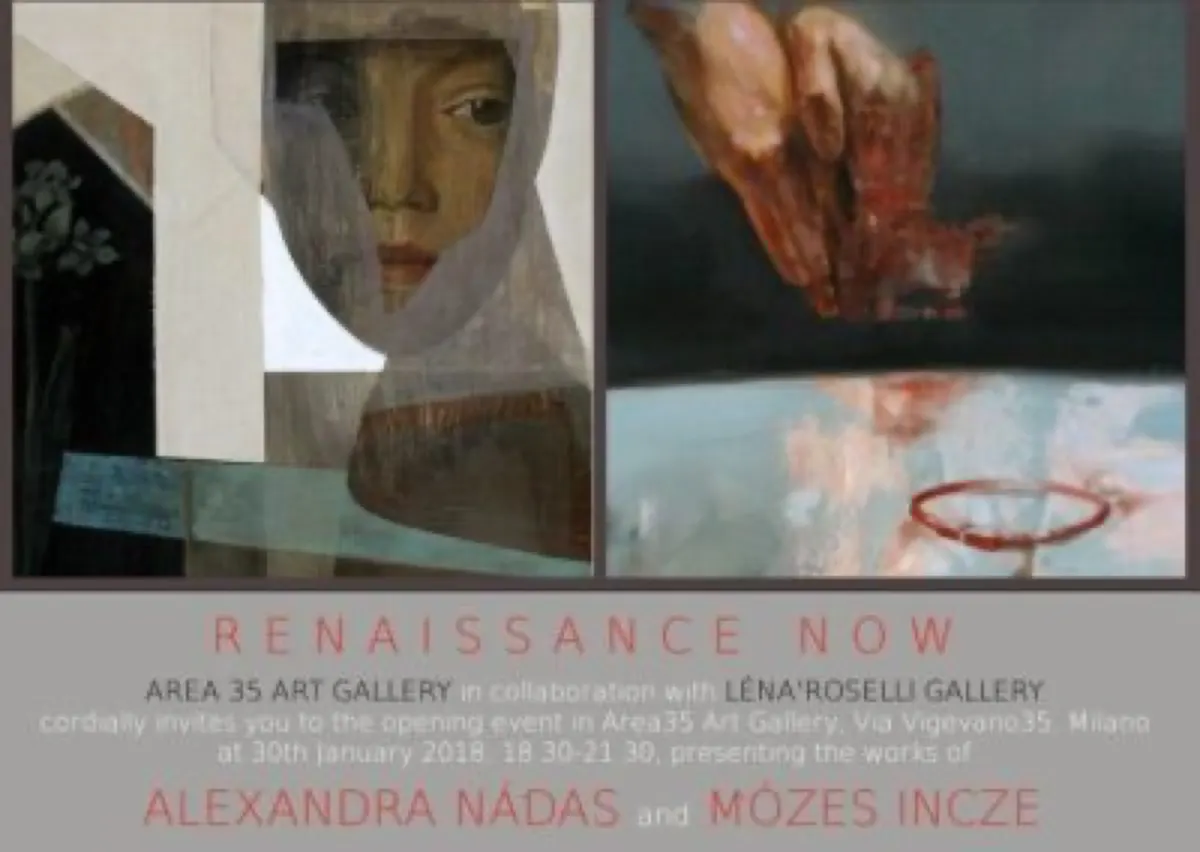
Area35 Art Gallery presents “Renaissance Now. Mozes Incze and Alexandra Nadas ”on display from January 31st to March 1st and curated by Lena Ilona Orosz. The exhibition stems from the desire of Area35 to join the BudArtPest project, whose goal is to create international cultural bridges and new connections through the art of Hungarian artists and the Central European intellectual community. Through their works, the Hungarian artists Mozes Incze and Alexandra Nadas represent the common cultural traditions between Italy and Hungary, in particular the link to the Renaissance and at the same time express new values linked to international society, hyper-connected technology and the virtual world, integral elements of today's everyday life. The art of Mozes Incze, based on the European pictorial tradition, proposes bodies, lights and atmospheres that recall Renaissance and classical styles in which the description of the natural elements is clear and detailed. A further element intervenes within his works, which dominates the scene and threatens the traditional binomial "Man and Nature": it is the "Machine Language" closely connected to the computer world. Nature does not dominate the scene on the contrary, it often appears confined to small objects such as vases and cups or can be seen within the curves of a body, while the human dimension is sometimes evoked by the delicate circle of a red ribbon that over time has become the artist's signature. The settings recreated within the works of Mozes Incze are above all cybernetic dimensions, desolate places, timeless and without a precise connotation, scattered with LED screens, mobile phones, flashes that add further meanings to the composition. These are unidentified spaces observed through a neural interface, the link between man and computer. The artist paints a hypothetical human asceticism, both biological and spiritual, which springs from the relationship at times of slavery, at times of complicity, with the nascent and cumbersome artificial intelligence. It is the contemporary, therefore, with its new customs and its cybernetic relationships, to be the protagonist. Inside the canvases, meticulous pictorial descriptions alternate with chaotic spots and gestures of creative decomposition: indefinite substances take the place of the solid form and appear to be living and throbbing beings - as if intent on corroding the surface of the canvas - that capture the viewer. The subjects, often busy with their work, seem to float in a space that belongs to the real as much as to the virtual; electronic instruments such as usb cables and power sockets peek out among elements of still life, the landscape is often reduced to the cameo of a lit screen. All the compositional elements accentuate the contrast between real and virtual contents, underlining the narration of a "hypertextual" world. In the works of Alexandra Nadas the link to the technical and stylistic tradition of the Renaissance is very evident in the choice of materials, plates made with oil colors and tempera and in the subjects, landscapes, architecture and portraits. However, the artist intervenes with solutions that substantially change the characters of the past for a contemporary interpretation. Architectural elements, for example, despite being a constant presence as in Renaissance works, are reinterpreted in a lyrical and narrative key. Houses, rooms, squares are taken from everyday life, from the municipality, from the intimacy of everyday life, they are no longer the archetypal element of solidity and foundation. This role is widely interpreted by the portrait and in particular by the profane madonnas, figures taken from the past, hieratic and iconic, majestic in their beauty, mysterious and imperturbable who become the center of the entire composition. The artist creates scenographies linked to the real world, through partially transfigured contemporary landscapes and excerpts of modern life, where elements are inserted that arouse amazement due to their placement not suited to a traditional set of the scene. Alexandra Nadas' research center is the reading of the present through the past which finds expression through a stratification of different components: physical, virtual, mental and spiritual. Biographical notes Mozes Incze was born in 1975, graduated from the Hungarian University of Fine Arts, has been awarded numerous national prizes including the Koller prize in 2011 and the Horvath Prize in 2016. Present in the Hungarian art scene, especially in the prestigious galleries of the capital, he founded in 1997 with other artists the Élesd Art Colony (school? Association ?, group?), an important quality contribution to the arts scene in Hungary. He has exhibited in solo and group exhibitions, among which they are also remembered in Italy and Switzerland, receiving recognition of talent at an international level.
Learn more: https://www.area35artgallery.com/exhibitions/61051e60b717bae7f8197cc4